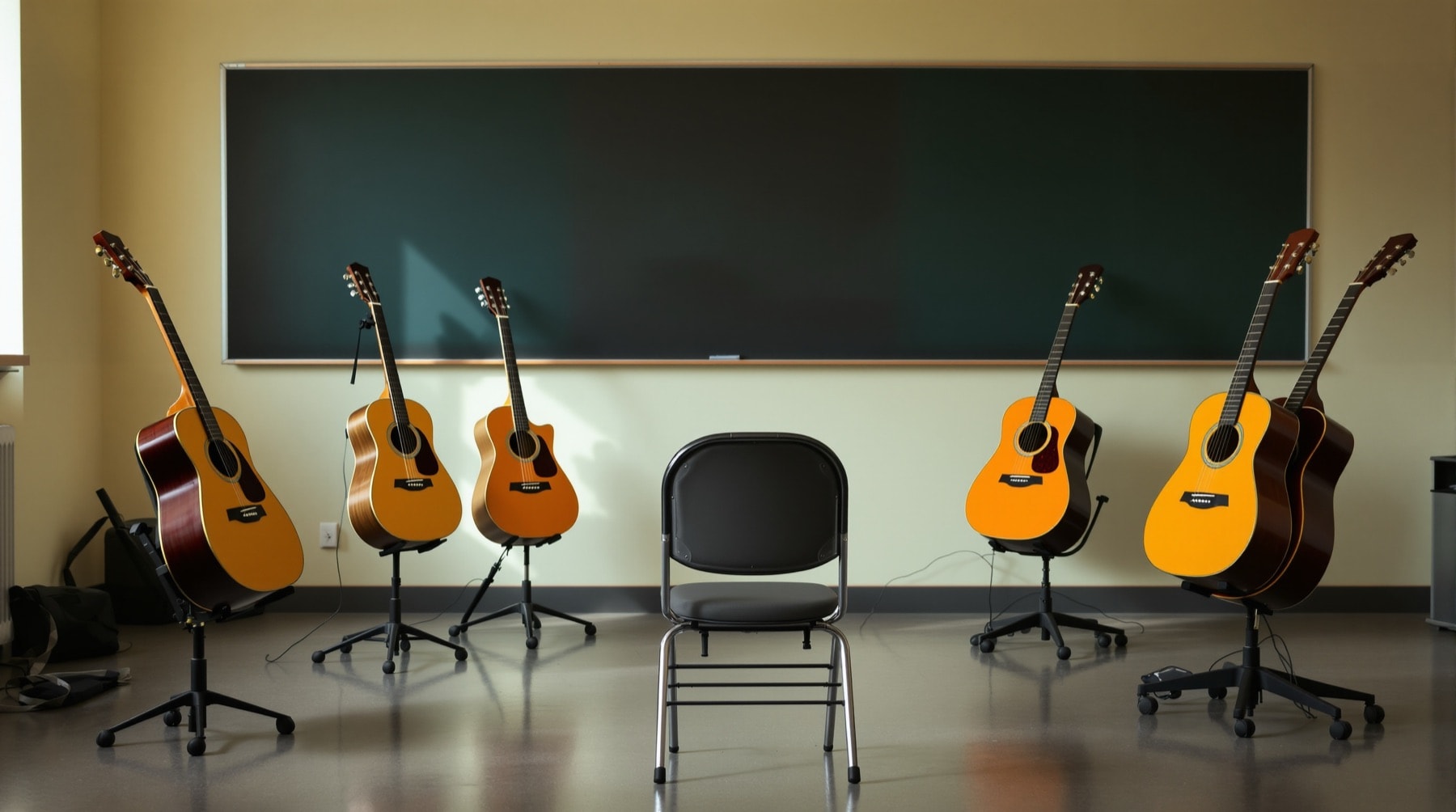
Classes
Every class ran every day. Each teacher took one class in the morning and a second in the early afternoon, and each lasted an hour and a half to two hours. You did not sign up in advance — you watched the demonstrations on the first evening and chose. What follows are the class descriptions as they were published.
Woody Mann
Different Styles — Common Sense
Basic fingerpicking ideas and approaches that connect the many seemingly unrelated styles of blues guitar playing. Whether it is a vocal song in open tuning from the Delta or a ragtime instrumental, the class focused on the overall techniques that let a player understand the various sounds of fingerstyle blues guitar in a clear, comprehensive way. Tunes came from the repertoire of Gary Davis, Scrapper Blackwell and Blind Lemon Jefferson, among others, and a good part of the time went on techniques for learning directly off the original recordings — a skill the seminar treated as a subject in its own right rather than a knack you either had or did not.
Syncopating The Dance
Syncopated fingerstyle picking technique, and practical approaches to "playing off" the chords within a song. The class worked on bringing out the top-line melody of a tune or phrase while keeping the picking swinging, and on demystifying the process of improvising your own variations while learning the repertoire of some of the master solo blues, ragtime and early jazz guitarists — Lonnie Johnson, Blind Blake and Big Bill Broonzy in particular. It was described, plainly, as a class for people who wanted to take alternating picking to the next level.
Special workshop session: Ragtime Blues.
Bob Brozman
Deep, Dark Delta Blues Roots
An attempt, in the class's own phrase, to "deconstruct the mysteries of the darkest sounds in Delta Blues." Through tunings and muscular ideas, students worked on how that special heavy feeling of the blues is generated through tone production in both hands — a distinction the class kept returning to, since most players arrive assuming tone lives in the left hand alone. Brozman also laid out the hidden structure which underlies all open tunings, and used a large stock of rhythmic ideas to get a unique bluesy quality of relaxed intensity into students' playing. Bring a bottleneck.
Rhythm in Your Riffs
"Between your two hands, your two feet, and your guitar, you've got enough rhythm to be the whole band." Using blues in standard and open G tunings and the styles of Charley Patton, Robert Johnson and Bukka White, the class travelled right up to the edge of swing guitar rhythm. Emphasis fell on getting your groove in a solid, relaxed feeling, with a full menu of percussive techniques on the table. Hidden conceptual tricks of Robert Johnson's standard-tuning playing were a recurring feature, along with what makes a great solo, break and riff. Some slide playing was covered here too.
Special workshop session: Slide Guitar Secrets and Rhythm Power.
Martin Simpson
Blues in Black and White
The basic use of tunings in traditional black and white blues, and the evolutionary relationship between the banjo and the guitar — the class treated tunings as a source of technique and of new ways to think about the instrument, rather than as a set of alternative pitches to memorise. Left-hand work covered economy of motion and tuning-mapping; right-hand work covered banjo-derived frailing, Carter-style picking, and more sophisticated four-finger picking ideas.
Expanding The Traditions
The second class explored Simpson's own expansion of the traditions of blues and British and American folk playing — how a player who has absorbed a tradition properly then departs from it without discarding it.
John Cephas
Cephas taught the Piedmont side of the tradition: the alternating-bass, ragtime-inflected East Coast style that sits at some distance from the Delta playing covered elsewhere in the week. Having both on the same timetable was deliberate. A student could spend the morning inside Delta rhythm and the afternoon inside Piedmont picking, and come away with a much better sense of what actually distinguishes them than any amount of reading provides.
The Toolbox classes
Alongside the two main slots sat the optional "Toolbox" classes — 45-minute sessions on the basics, taught for several years by Orville Johnson. These existed for a specific reason. Because the main classes were organised by subject rather than skill level, a genuine beginner could easily choose a class whose material outran them. The Toolbox slot gave that student somewhere to shore up fundamentals in the same week, without being separated out into a beginners' track. Later-year timetables also carried a second Toolbox slot in the mid-afternoon.
Requesting a class
Students could ask for a class on a subject of their choice. An instructor would announce it to the whole seminar and anyone interested joined, usually in an informal gathering in the late afternoon. Topics that came up often enough to be listed in the programme included Country Blues Songwriting, First Time Performing, Practical Theory, The Music of Skip James, How to Practice, Amplifying Your Guitar, Early Jazz and Blues Styles, Blues to Jazz, and Open Tunings.
The full daily shape of the week is on the programme page, and the players whose recordings underpin all of the above are covered in the repertoire and tunings pages.
Archive note. International Guitar Seminars is no longer operating and this page is preserved for the record. There is no session to register for, nothing is offered for sale here, and the pages carry no contact details.